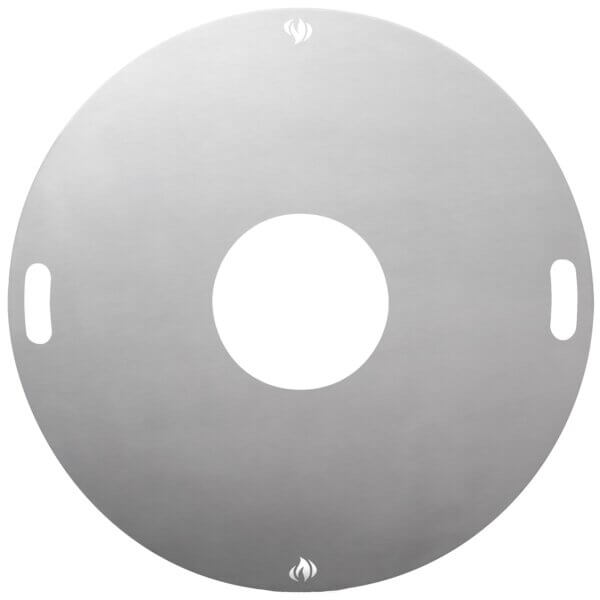
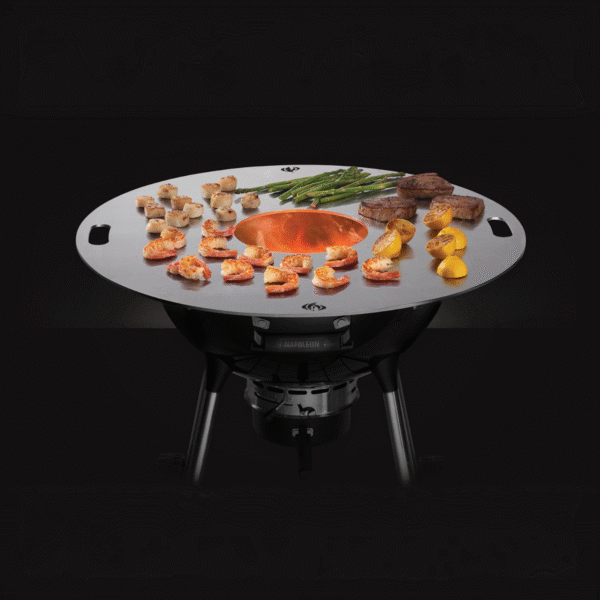
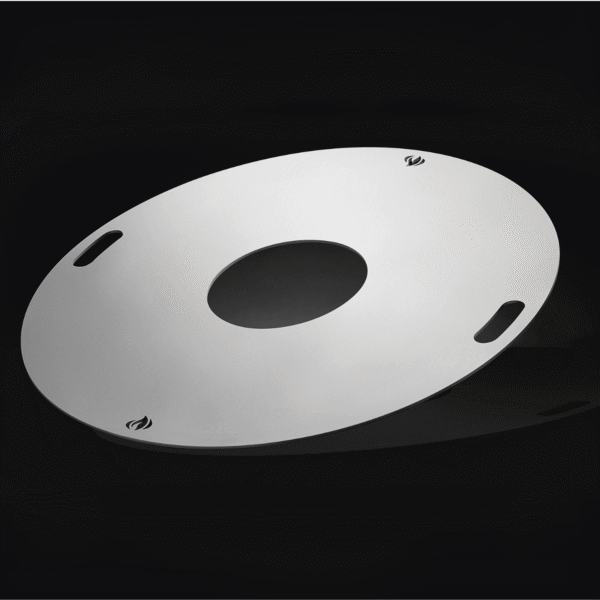
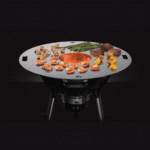
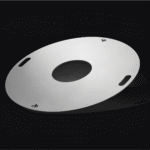
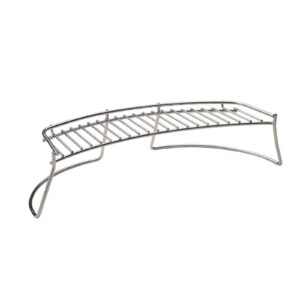
The Hot Plate – Napoleon turns any Ø 47 or 57 cm kettle into a versatile outdoor griddle with distinct heat zones. Its 5 mm hot-rolled steel accumulates and distributes heat with authority, allowing you to sear in the centre and cook gently around the perimeter with total control. What’s more, its robust, universal design makes it compatible with other kettles and heater barrels.
🧱 Materials and construction
Made of 5 mm hot-rolled steel, this plate focuses on thermal inertia and mechanical stability. The thickness provides mass to cushion temperature drops when you load the griddle and reduces cyclic deformations, extending its useful life even during long sessions with red-hot charcoal.
🔥 Key features
The surface generates progressive heat zones from the centre outwards, so you can sear meat intensely in the centre and move food that needs gentler cooking or keeping warm to the edge. The centre maintains the character of the embers and encourages the drainage of juices and excess fat without flooding the surface.
⚡ Performance and thermal efficiency
The combination of solid steel + 5 mm offers uniform heat retention and distribution, which translates into fewer temperature fluctuations and consistent cooking marks. This behaviour makes cooking times more predictable and improves the Maillard reaction in quick grilling, especially for thin cuts and smash burgers.
🎨 Design and aesthetics
Its large diameter ring format maximises the usable surface area without compromising the ventilation of the heater. Visually, it has a ‘feuertonne/plancha’ look that invites social cooking, with the spectacle of the charcoal on display in the centre and a wide cooking ring around it.
🔗 Compatibility and scope of use
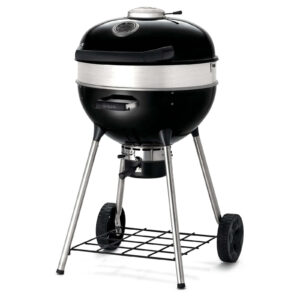
It is designed for Napoleon kettles with a diameter of 47 and 57 cm, but its use is universal: it can be placed on other kettles and heater barrels that offer a stable seat of the appropriate diameter. This allows you to take it to different barbecues or a contained bonfire in the garden without changing your technique.
🍳 Benefits for different cooking styles
On the barbecue, it harnesses the power of charcoal for quick searing; in outdoor cooking, it functions as a classic griddle for fish, seafood, vegetables and full breakfasts; and in mixed cooking, it allows you to sauté in the centre and confit or glaze around the edge, all at the same time, with smooth steps between zones.
🛡️ Safety and ease of use
The weight and stability of the piece reduce vibrations and help you cook with firm utensils without the plate ‘dancing’. The warmer perimeter makes it easier to manage resting pieces and minimises overcooking errors. Like all raw steel griddles, it develops a protective patina with use, which improves its natural non-stick properties over time.
🌍 Applications beyond the barbecue
Beyond the grill, it performs well in barrels/feuertonas as a cooking ring for gatherings on the terrace or in the garden, integrating ambient fire and griddle in one place. It also works on country stoves if the support is stable and the diameter allows it.
Use and Maintenance
This plan brings together
specific best practices for 5 mm hot-rolled steel plates used on kettle-type barbecues (Ø 47/57 cm) and fire barrels. The aim is to
protect the patina, optimise
heat retention and distribution, and extend the
service life of the part. If you have the
manufacturer's manual, always use it as your primary reference: the following is a safe and proven guide for demanding domestic use.
Start-up / Initial curing (detailed)
- Pre-washing: step with a sponge and hot water and a drop of neutral soap to remove factory oils. Rinse and dry thoroughly.
- First heating: place the plate on the kettle with lit charcoal; let 10–15 minutes pass until it is hot and any moisture has evaporated.
- Light oiling: apply a very thin film of high smoke point oil (rapeseed, peanut or high oleic sunflower). Remove excess with paper; the surface should look satin, not shiny.
- Polymerisation: let the oil smoke slightly and darken the plate. This change in tone is the beginning of the patina.
- Repeat layers: apply 2–3 more layers (very thin oil + heat) to consolidate. Avoid oil puddles: they create sticky spots.
- Gradual cooling: cut off the air flow or move the plate away from the heat source, and let cool without water. Thermal shocks can put stress on the steel.
- Check: when finished, you will see an uneven dark brown/black tone. This is normal: the patina will even out with use.
Use in each session (step-by-step operation)
- Preheat with zones: concentrate more charcoal under the centre for high temperature and let less fuel under the outer ring for medium heat.
- Surface test: bring a drop of water close; if it ‘dances’ and evaporates almost instantly in the centre, you have a sealing zone.
- Functional oiling: a thin layer of oil with paper is sufficient. Excess oil cools the plate and promotes smoke.
- Smart cooking: seal in the centre and finish/maintain on the edge. Move the pieces according to their reaction; if the surface loses its sparkle, let it rest for 20–30 seconds to regain temperature.
- Juice management: drag the juices towards the open central area or towards a deglazing point to avoid ‘flooding’ the griddle.
- Between batches: scrape off residue with a rigid metal spatula and step with paper. If necessary, use a minimal amount of hot water to deglaze, never cold.
- End of service: before turning off, scrape, dry and apply a very thin film of oil to seal the patina until the next session.
Cleaning (quick and thorough)
Quick cleaning, with the plate warm:
- Scrape off residue with a spatula at a low angle.
- Deglaze with a few drops of hot water if there are any stuck-on bits; remove the emulsion with paper.
- Dry thoroughly and apply a very thin layer of oil to protect.
Deep cleaning, if there were sugary sauces or sticky marinades:
- With the plate warm, rub with coarse salt and a minimal amount of hot water; this acts as a mild abrasive.
- Remove, dry and re-oil.
- If the patina is dull or patchy, apply 1 extra coat of curing agent (thin oil + heat until smoking).
Maintenance (weekly/monthly)
- Patina inspection: look for light areas or snuffer rings; correct with a localised coat of curing agent.
- Surface rust: remove with a fine scouring pad or 000 steel wool, clean, dry and cure with 1–2 coats.
- Storage: dry place, lightly oiled plate and, if possible, wrapped in kitchen paper or a breathable cover.
- Normal warping: small concavities due to expansion are common and do not affect performance. These are balanced out by the dough and use.
Safety (extended)
- PPE: use heat-resistant gloves and long-handled utensils; avoid loose clothing.
- Stability: check that the plate is securely seated in the kettle or barrel before lighting. Level surface = fewer spills.
- Fat control: keep the central opening clear and avoid pouring excess oil to prevent flare-ups.
- Ventilation: cook outdoors or in well-ventilated areas.
- No cold water: never cool suddenly with water; in addition to splashing, it causes thermal shock.
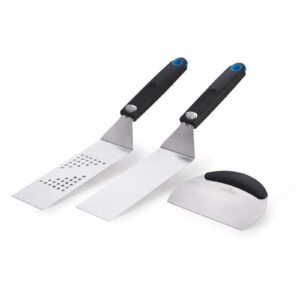
- Tools: rigid spatulas, scrapers and sturdy tongs reduce the risk of slipping.
Storage and transport
- Let cool to room temperature before moving.
- Remove ashes from the kettle and store the oiled plate.
- For transport, interleave with cardboard or paper to prevent scratches; secure so that it does not hit the edges.
Troubleshooting (quick)
- Food sticks: the plate was cold or lacked patina. Solution: preheat more, add thin oil and move only when it comes off on its own.
- Light/irregular stains: young patina. Solution: 1–2 extra coats of curing after cleaning.
- Excessive smoke: excess oil or sugary residue. Solution: scrape, deglaze with minimal hot water and oil more thinly.
- Light rust: moisture in storage. Solution: fine scouring pad, dry completely and re-oil.
- Loss of ‘spark’ when sealing: food overload. Solution: cook in batches and alternate centre/edge for heat recovery.
Quick checklist before cooking
- Charcoal lit and zones defined (high centre/medium edge).
- Dry and satin-finished plate with fine oil.
- Rigid spatula, tongs and heat-resistant gloves at hand.
- Paper for cleaning between batches.
- Container for deglazing and collecting juices.
Garlic prawns and asparagus (Napoleon heater)
This recipe is designed to make the most of the
hot centre of the heater and the
warmer outer ring. The prawns are quickly seared to keep them juicy, while the asparagus is cooked to perfection on the edge. The garlic sauce is prepared in seconds on the hotplate to coat everything with its aroma.
Ingredients (4 servings)
Prawns and asparagus
- 16–20 large prawns (raw, shelled or peeled to your liking)
- 2 bunches of green asparagus (500–600 g), woody ends removed
- Fine salt and black pepper
Quick marinade
- 2 tablespoons mild olive oil or sunflower oil (for high temperature)
- Zest of 1 lemon
- ½ tsp sweet paprika
- 1 clove garlic, finely chopped
Final “ajillo”
- 4–5 cloves garlic, sliced
- 1 dried chilli or ½ tsp chilli flakes (adjust to taste)
- 3 tbsp mild olive oil (and raw EVOO to finish)
- 1 tbsp chopped fresh parsley
- Juice of ½ lemon
- (Optional) 60 ml white wine for deglazing
Steps to follow
- Prepare the fire and cooking areas. Light the charcoal and place the griddle on top. Let the centre reach a very high temperature (a drop of water will “dance” and evaporate instantly) and the edge reach medium heat. Grease the surface with a thin film of oil.
- Marinate while heating. Mix the prawns with the quick marinade, season lightly with salt and pepper and let them rest for 10–15 minutes.
- Asparagus first. Place them in the middle ring with a thin layer of oil. Cook for 2–3 minutes on each side until marked; season at the end so they don't sweat excessively. Move the cooked ones to the perimeter to keep them warm without overcooking.
- Flavour the oil (garlic base). In a medium area, add the garlic oil, chilli pepper and sliced garlic. Cook for 20–40 seconds until the garlic is just seared without burning. Push this flavoured oil to one side to use as a finishing touch.
- Prawns in the centre. Turn up the heat to very hot and place the drained prawns in the centre. Cook for 45–60 seconds on each side until they turn a deep pink colour and are opaque. Season to taste.
- Drizzle and (optional) deglaze. Pour the garlic oil over the prawns and sprinkle with parsley. If you want extra juice, deglaze the centre with white wine for 5–10 seconds and scrape up the juices with a spatula; pour over the top.
- Finish and serve. Squeeze the lemon, add a drizzle of raw EVOO, mix with the asparagus from the perimeter and serve immediately.
Control tips: If the garlic sears too quickly, move it to the warm ring; if the prawns sweat too much, move them to the centre for 10–20 seconds to regain temperature and seal.
Vegetarian variation of Mushrooms with garlic and asparagus
Substitutions
- Replace the prawns with 600–700 g of mushrooms (oyster, cardoon or portobello, thickly sliced).
- Add toasted flaked almonds or pine nuts to give texture at the end.
How to make it
- Mix the mushrooms with 2 tablespoons of mild oil, lemon zest, ½ teaspoon of paprika, 1 clove of minced garlic, salt and pepper. Let stand for 10 minutes.
- Cook the asparagus as in the basic recipe and set aside on the perimeter.
- Sauté the mushrooms in the centre in batches so that they sear and do not boil: 2–3 minutes per side until crispy around the edges.
- Prepare the ‘ajillo’ over medium heat with oil, garlic and chilli pepper for 20–40 seconds. Drizzle the mushrooms and asparagus with this oil, add parsley, a dash of lemon juice and finish with toasted nuts.
Done! You have a seafood version and a 100% vegetable version, both designed to take advantage of the
two zones of the Napoleon Heater and serve steaming hot at the table.